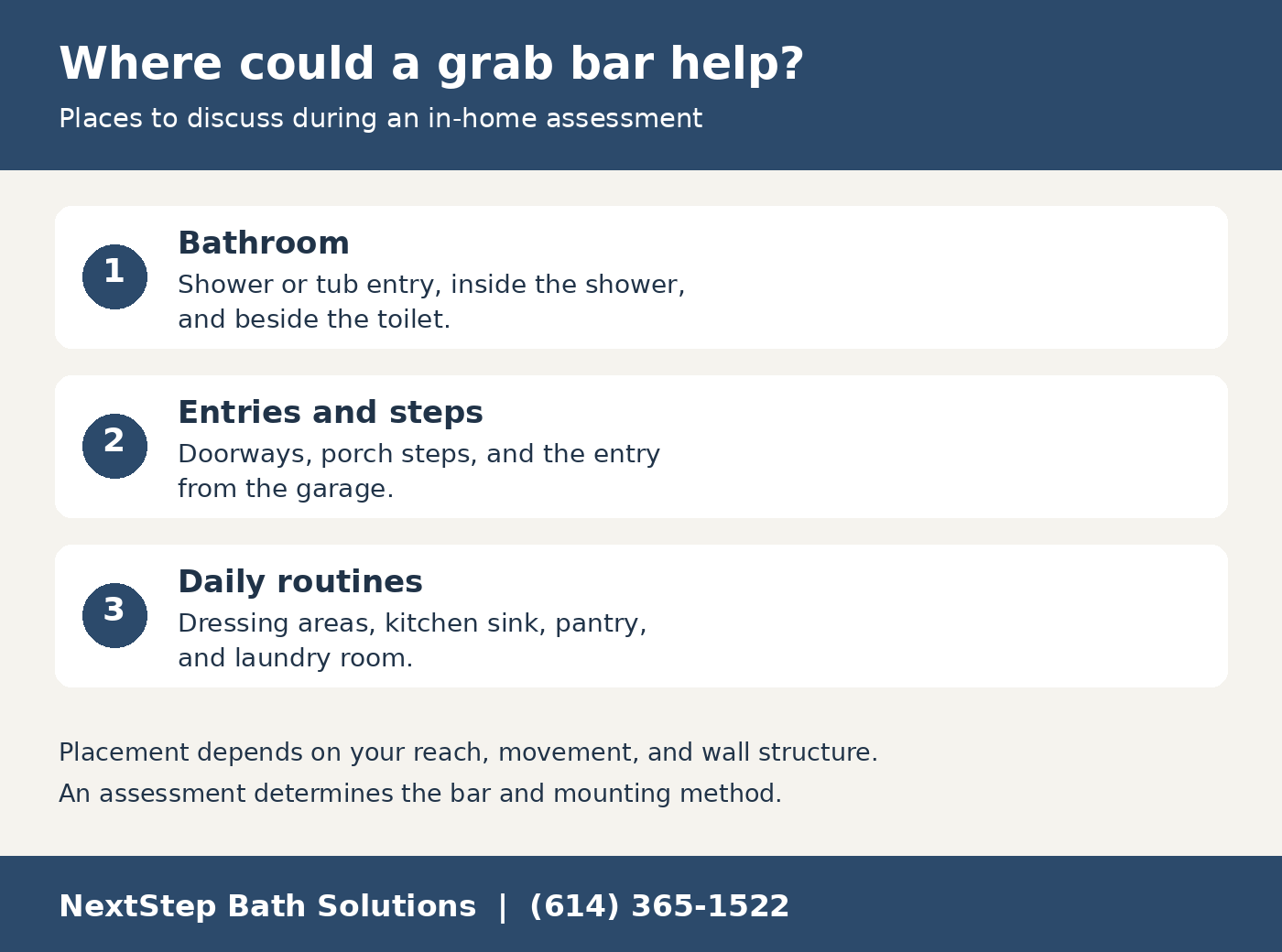
A toilet grab bar should fit the person using it and the support available in the wall.[1] For adult ADA layouts, horizontal bars sit 33 to 36 inches above the finished floor, measured to the top of the gripping surface.[15] That is a reference for planning, not a universal drilling height for a private home. Start by discussing reach, the approach to the toilet, and which movements need support.
Choose the side before choosing the bar
There is no rule that every toilet needs its bar on the right or on the left. The U.S. Access Board allows either a left-hand or right-hand approach in its accessible toilet layouts.[14] Its standard calls for grab bars on the side wall closest to the toilet and on the rear wall, subject to the stated exceptions.[15]
For your bathroom, bring these questions to the placement discussion:
- Which hand can the person use comfortably?
- Is the difficult part sitting down, standing up, or transferring from a wheelchair?
- Where are the walls in relation to the toilet?
- Will a walker, wheelchair, door, or caregiver need room beside it?
- Is the toilet itself being replaced as part of the work?
NextStep’s grab bar installation service considers the user’s reach and mobility needs along with the wall and mounting system.[1] Describe the movement that is difficult rather than ordering a bar solely because it fits an empty patch of wall.
If you need hands-on help with transfers or have movement restrictions from a medical condition or surgery, ask your treating occupational or physical therapist for placement guidance before installation. Do not attempt an unsupported transfer to demonstrate a problem.
Understand what the height measurement means
The ADA’s adult horizontal-bar height is 33 to 36 inches from the finished floor to the top of the gripping surface, not the center of the bar, mounting plate, or screw hole.[15] Measuring from the wrong point changes the installation.
These federal standards do not apply to individually owned or leased private housing that is not used as a public accommodation; state or local accessibility requirements can still apply.[16] Confirm the requirements for your project rather than assuming every bathroom has the same legal scope.
For a home placement discussion, consider the user’s height and reach as well as the wall structure.[1] If the toilet or seat will change, tell the installer before settling the bar position. You can also review NextStep’s toilet installation service when discussing the scope of the bathroom work.
Length includes where the bar starts and ends
A bar’s advertised length does not tell you where it will sit beside the toilet. In the standard adult ADA layout, the side-wall bar must be at least 42 inches long, start no more than 12 inches from the rear wall, and extend at least 54 inches from that wall.[15] All of those conditions matter; meeting the length alone is not enough.
The rear-wall bar has a different requirement: at least 36 inches long, extending at least 12 inches from the toilet centerline toward the wall side and at least 24 inches toward the open side.[15] The standard includes specific exceptions for certain rear-wall obstructions.[15]
Use these dimensions to understand an accessible layout, not as a shopping list for every home. Ask the installer to show the proposed gripping area in relation to the toilet and the user’s reach before approving the location. A diagram for an adult wheelchair-accessible toilet also should not be treated as a complete plan for a child or every other type of accessible compartment.
When there is no useful side wall
Ask whether a different support arrangement needs evaluation. Do not assume a fold-down rail can attach to any wall or replace every required bar.
The Access Board permits additional folding or swing-away bars on the open side of an accessible toilet when they do not interfere with the required bars or clear floor space, and stresses secure attachment.[14] That permission does not make one a substitute for the required side and rear bars in an ADA layout.[14]
For a home, have the proposed product, attachment, clearance, and transfer path reviewed together. Confirm that the installer offers the selected system before buying it. This guide does not specify a fold-down product or its weight limit.
Leave room for a hand, and check the support behind the wall
The ADA standard specifies 1½ inches between the wall and grab bar. It also requires clearance from projecting objects: at least 1½ inches below and at the ends, and generally 12 inches above, with specified exceptions.[15] A toilet-paper holder or shelf therefore belongs in the placement discussion too.
Mounting strength involves more than the metal bar. The ADA structural requirement addresses a 250-pound vertical or horizontal force at any point on the bar, fastener, mounting device, or supporting structure.[15] That force requirement is not a personal weight rating for an unspecified product. Follow the selected product’s load limits and installation instructions.[1]
NextStep describes mounting into suitable studs or using a purpose-designed grab-bar anchoring system approved for the wall and product; ordinary drywall anchors are not a substitute.[1] Ask what supports each mounting point and whether the wall needs additional work.
What to bring to the estimate
Before the visit, make a short list of what needs attention:
- The movement that is difficult and any guidance from a treating therapist.
- Any planned toilet or seat replacement.
- The mobility equipment used in the room.
- Whether you want toilet-area support only or other bathroom changes assessed.
You do not need a finished placement plan before asking for help. To discuss your bathroom, schedule a free in-home estimate with Paul or call (614) 365-1522.[3]
Sources
Sources reviewed September 29, 2026.