Grab bars can be installed through some tile, fiberglass and acrylic wall assemblies, but the finish alone does not tell you which mounting method is suitable.[10][13] Before approving the work, ask the installer to identify the wall layers, support and exact hardware. Manufacturer instructions distinguish specific wall materials and thicknesses, and some systems also need a minimum clear space behind the wall.[10][13]
This is a guide to comparing an installation proposal, not a drilling tutorial. The product instructions for your wall and grab bar control the work.
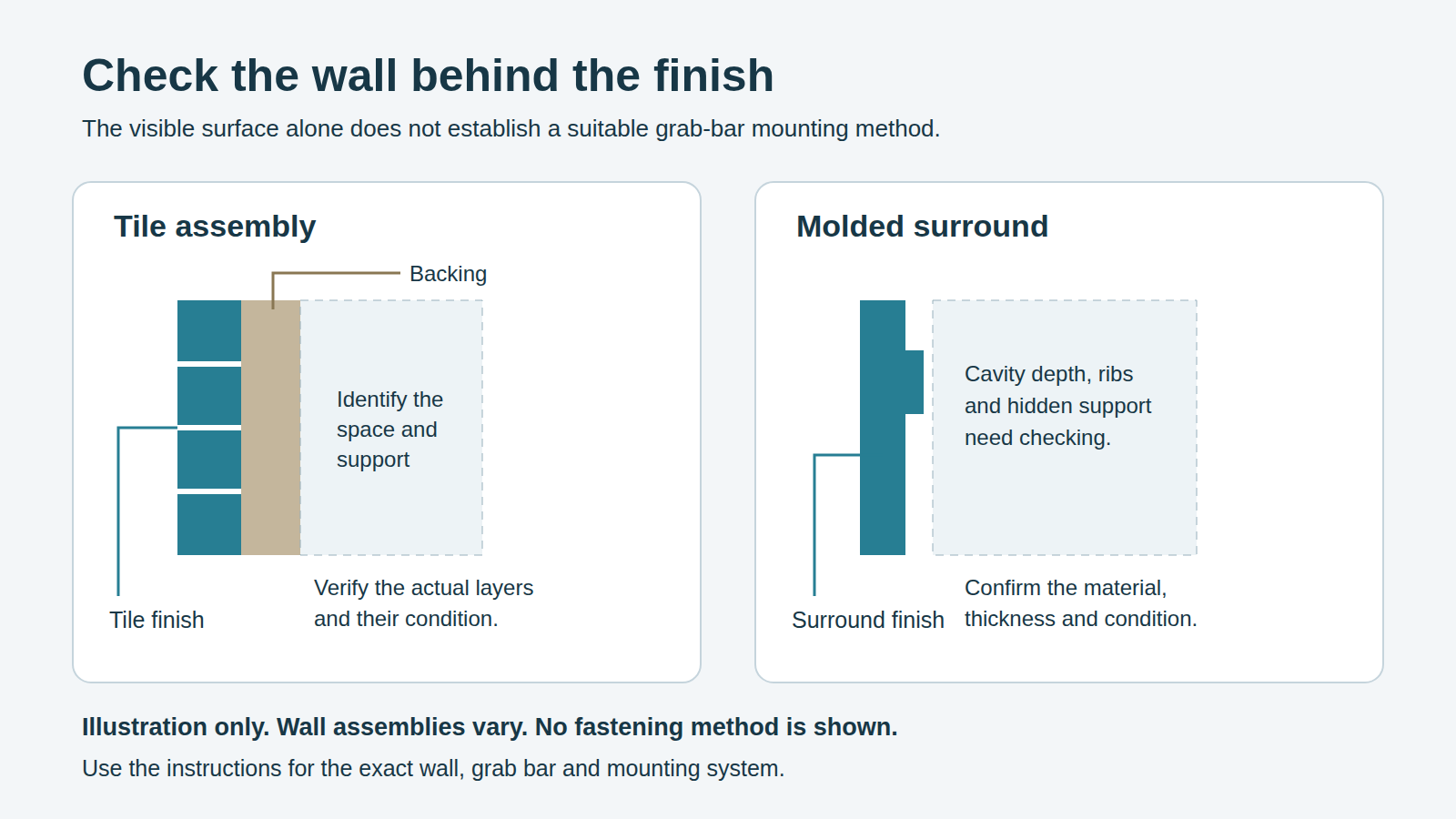
Tile: identify the tile and what sits behind it
Ask two separate questions: what material must the drill cut, and what will support the bar?
Ceramic and porcelain are not interchangeable when choosing a drilling tool. WingIts says its Apache bits are for ceramic wall tile and marble, while porcelain and granite require diamond hole saws.[13] That is guidance for those tools, not a reason to select a hole size before choosing the mounting system.
The backing matters too. Moen’s SecureMount anchor instructions list specific assemblies, including 1/2-inch or 5/8-inch drywall with tile, and require 3 1/2 inches of space behind the wall.[10] A description such as “tile shower” leaves those details unanswered.
Ask the installer to name the approved wall assembly in the instructions. Do not treat a listed drywall-and-tile assembly as automatic approval for every other backing material.
For the broader explanation of studs, blocking and approved anchors, read our guide to grab-bar mounting and wall support.
Fiberglass: check thickness, shape and the space behind it
A fiberglass surround needs a mounting plan specific to its construction. For example, Moen’s cited SecureMount instructions list 1/8-inch or 1/4-inch fiberglass tub surrounds and require at least 3 1/2 inches of space behind the surface.[10] They also prohibit installation on a curved surface and on weakened or damaged substrates.[10]
Those restrictions explain why the bar’s proposed position needs more than a mark on the wall. Ask whether each mounting plate will sit on a permitted surface and whether there is room for the specified hardware behind it.
Moen also directs installers to locate studs and check for plumbing, electrical wiring and obstructions such as adhesive beads or ribs in tub surrounds before drilling.[10] An installation proposal should account for what is hidden, not simply name the visible finish.
Acrylic: get approval for the exact surround and fastener
Do not assume hardware approved for a tiled wall is also approved for an acrylic surround. WingIts distinguishes stainless-steel-wing fasteners from its plastic-wing products and says only the stainless-steel-wing fasteners are acceptable for acrylic or fiberglass surrounds.[13]
Its FAQ gives a specific example: the stainless steel Beast GBW40 grab-bar fastener can be used in fiberglass or acrylic surrounds when the surround is at least 1/4 inch thick and is not deteriorating.[13] That statement does not approve every WingIts fastener, every grab bar or every acrylic panel.
The useful question for an estimate is: “Which product instructions cover this exact wall and bar?” If the wall construction is unknown, ask what must be established before the installer can select a mounting method.
The named products here illustrate manufacturer limits. They are not a statement that NextStep stocks or installs those systems.
Sealing belongs in the installation plan
Ask how the selected system handles water at the mounting points. Moen’s cited SecureMount instructions include a water-resistant gasket and direct the installer to use silicone to fill gaps between an uneven surface and the mounting plate.[10]
That detail is specific to the system. Ask for the sealing method required by the chosen hardware and wall manufacturer rather than applying one caulking rule to every surround. Sealant is not a reason to ignore a prohibited surface or an unsuitable wall assembly.
What to ask before accepting the estimate
Use these questions to make the proposed work clear:
- What are the wall material, backing and thickness at each mounting point?
- Which grab bar and mounting hardware are proposed, and which instructions approve that combination?
- Does this system require clear space behind the wall, and has that space been checked?
- If the intended location does not meet the product requirements, what other location or wall work would you recommend?
- How will the mounting points be sealed, and what inspection or care instructions will I receive?
You do not need to choose an anchor before asking for help. Start with the problem: where you need support and which part of the bathroom is difficult to use.
Discuss grab-bar installation in your bathroom
NextStep Bath Solutions offers grab-bar installation in Columbus and Central Ohio.[1] Ask Paul to assess the wall and your support needs.
Request a free in-home estimate