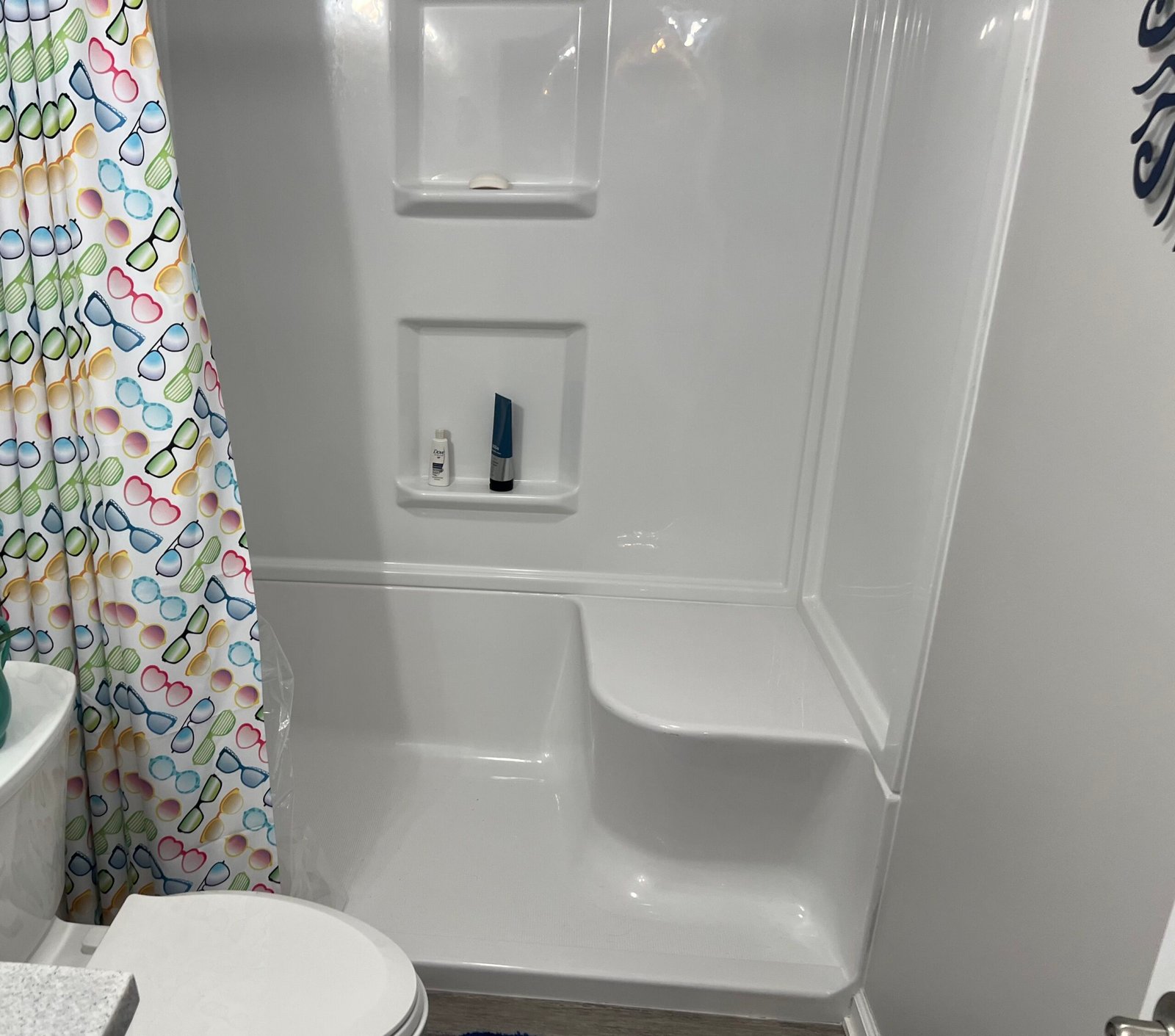
Acrylic shower walls usually cost less to install and take less work to clean because large panels replace hundreds of tile and grout joints. Tile gives you more freedom in pattern, color, niche shape, and trim. It can also be repaired in smaller sections, but the finished tile is only one part of the shower. The waterproofing behind it matters just as much.
For a Columbus homeowner who wants a practical shower with low upkeep, acrylic is often the simpler choice. Tile makes more sense when a custom look matters enough to justify more installation time, grout care, and a more complicated repair path.
At-a-glance comparison
| Question | Acrylic wall panels | Tile shower walls |
|---|---|---|
| Upfront cost | Usually lower because the wall system installs without setting and grouting individual tile | Usually higher because labor includes substrate preparation, waterproofing, layout, setting, grouting, and trim |
| Routine cleaning | Smooth panels with a small number of seams | Tile faces are easy to wipe, but grout joints need separate attention |
| Design freedom | Limited to the colors, textures, patterns, and trim offered by the wall-system manufacturer | Broad choice of tile size, pattern, color, niche details, and trim |
| Small repairs | Some light surface damage may be repairable, depending on the product; panel or seam damage can involve a larger section | A damaged tile or grout area can sometimes be repaired locally, but the cause of the failure still has to be found |
| Waterproofing | Depends on the complete panel system, seams, base connection, and installation | Tile and grout are not the waterproof layer; the shower needs a sound waterproof assembly behind the finish |
| Best fit | Faster installation and lower cleaning burden | Custom appearance and detailed design control |
Why acrylic usually costs less to install
Acrylic wall systems arrive as large panels or multi-piece kits. One American Standard wall set, for example, installs without tiling or grouting, and its panels can be trimmed to fit.[3]
A tile shower requires more steps. The installer has to prepare a suitable substrate, build or install the waterproofing system, lay out the tile, cut it around plumbing and corners, set it, grout it, and finish changes of plane. TCNA warns that showers require proper installation and that grout joints are not waterproof.[2]
That does not produce one honest price difference for every bathroom. Demolition, hidden water damage, plumbing changes, shower-base work, accessories, wall dimensions, and product selection can outweigh the wall finish itself. Compare written scopes, not just the number at the bottom.
Ask both contractors to identify:
- What comes off the wall.
- What substrate and waterproofing go back in.
- How the wall meets the shower base.
- How corners, plumbing penetrations, shelves, and trim are sealed.
- What the labor and product warranties cover.
Cleaning: the grout is the dividing line
Acrylic panels have broad, smooth faces and far fewer joints than a tile wall. The American Standard example describes its smooth walls as easy to clean and as a low-maintenance alternative to tile.[3]
Tile itself is not necessarily difficult to clean. TCNA says tile can often be cleaned with water. Cementitious grout is the part that changes the routine because it is porous and can absorb stains. TCNA recommends following the grout and sealer manufacturer’s instructions and says many owners seal cementitious grout to reduce staining.[1]
Cleaning also depends on the exact product. Abrasive pads or the wrong chemical can dull or scratch some acrylic finishes. Acidic cleaners can attack cement-based grout. Keep the care sheet for the installed wall system and follow it instead of relying on a one-size-fits-all bathroom cleaner.[1]
Repair: small surface damage and system failures are different problems
A light scratch on acrylic is not the same as a cracked panel, failed seam, or loose wall. Ask the manufacturer or installer whether the specific finish can be polished or repaired and whether a repair affects the warranty. If a panel or sealed joint has failed, the repair may involve more than the visible mark.
Tile can be repaired in a smaller area when the problem is limited to a tile or grout joint. Matching an older tile can be difficult, and a cosmetic patch will not fix movement, poor bonding, or water getting into the assembly. TCNA says a repair that does not address the cause may not last. It also says cracked grout cannot simply be covered with new grout; enough old grout must be removed for the repair.[5]
The useful question is not, ‘Can this material be repaired?’ Both can. Ask how the contractor will identify the cause, protect the waterproofing, match the finish, and warranty the repaired area.
Longevity depends more on the assembly than the sales label
There is no single defensible lifespan for every acrylic or tile shower. Product quality, wall preparation, waterproofing, daily use, cleaning products, ventilation, movement in the structure, and installation quality all change the result.
Tile can stay serviceable for a long time, but tile and grout do not make the shower waterproof. TCNA says wet-area protection must come from the installation method and substrate.[2] Schluter makes the same point in its explanation of tiled showers: ceramic and stone finishes are not inherently waterproof and must be paired with a moisture-management system.[4]
Acrylic also depends on details you cannot judge from the color sample. The substrate has to be sound. Panels must be cut and supported correctly. Seams, plumbing penetrations, corners, and the base connection must be sealed as the manufacturer requires.
When comparing warranties, check:
- whether labor and materials have separate terms;
- who handles a claim;
- whether caulk or seam maintenance is excluded;
- whether improper cleaners void coverage;
- whether the warranty transfers to a future owner;
- what costs are excluded, including removal, shipping, or reinstallation.
Which wall belongs in your bathroom?
Choose the wall system around the way the bathroom will be used.
Acrylic is the practical fit when cleaning effort, project time, and predictable upkeep matter most. It also works well when the goal is a safer shower rather than a fully custom tile design.
Tile is the better fit when the design depends on a particular pattern, shape, niche treatment, or material and you are comfortable maintaining grout and paying for the added installation work.
NextStep Bath Solutions installs acrylic or solid-surface shower walls, paired with a properly built shower base. Full custom tile shower walls are outside NextStep’s service scope. Homeowners comparing a complete conversion can review the tub-to-shower conversion service and the Columbus walk-in shower guide.
Questions to ask before signing
- What exact wall product and thickness are in the quote?
- Is it acrylic, fiberglass, solid surface, laminate, or another material?
- What will be behind the finished wall?
- How are the corners, seams, valve, shower arm, shelves, and base sealed?
- Which cleaners are approved?
- What routine caulk or seam maintenance is required?
- Can a damaged panel, tile, or trim piece be replaced later?
- Will the installer leave spare tile or product information?
- Are the product and labor warranties written separately?
Frequently asked questions
Are acrylic shower walls cheaper than tile?
They are usually cheaper to install because large panels replace the layout, cutting, setting, and grouting required for tile. The final project price still depends on demolition, plumbing, the shower base, accessories, and hidden repairs.
Are acrylic shower walls easier to clean?
Usually. Acrylic has broad smooth surfaces and fewer joints. Tile faces are also easy to wipe, but cementitious grout is porous and may need more focused cleaning and sealing.[1][3]
Does tile last longer than acrylic?
A blanket lifespan claim is not useful. Either system can fail early when the substrate, waterproofing, seams, or installation are wrong. Compare the exact products, assembly, warranty, and installer rather than relying on a material label.
Can scratched acrylic be repaired?
Some light surface damage can be repaired, but the correct method depends on the product and finish. Use the manufacturer’s instructions. A cracked panel, failed seam, or loose wall is a different repair and needs a cause assessment.
Is tile grout waterproof?
No. TCNA says grout joints are not waterproof. A tiled shower needs a suitable installation method and substrate to protect the wall assembly from water.[2]
Talk through the wall system before buying
NextStep can inspect the existing shower, explain what can stay and what has to come out, and price an acrylic or solid-surface wall system for the room.
Sources
- Tile Council of North America, Cleaning Grout, accessed August 31, 2026.
- Tile Council of North America, Ceramic Tile, accessed August 31, 2026.
- American Standard, Mainstream acrylic shower wall set, accessed August 31, 2026.
- Schluter, Tiled Shower Waterproofing Systems, accessed August 31, 2026.
- Tile Council of North America, Cracked or Loose Grout, accessed August 31, 2026.