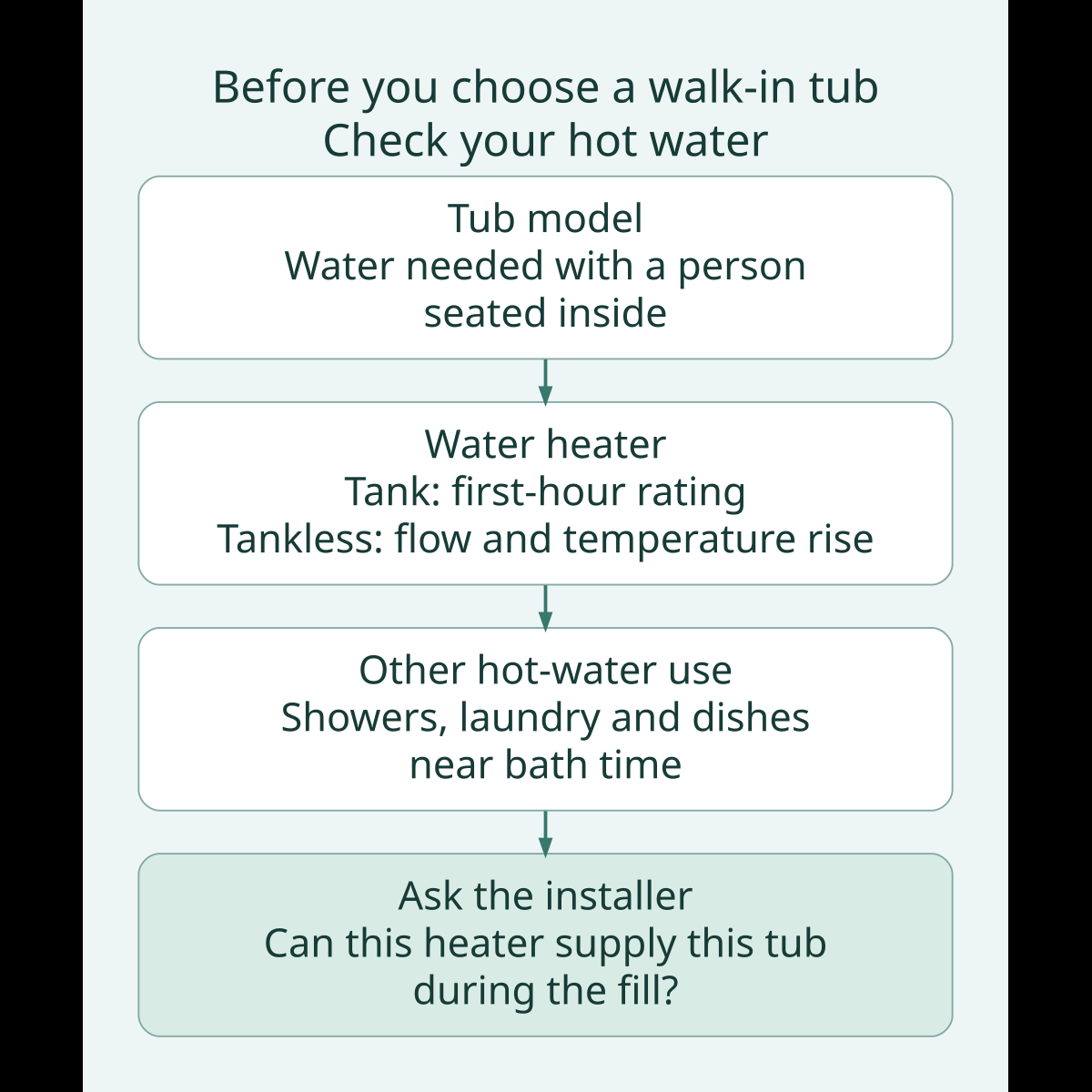
The tank size on your water heater label does not tell you whether it can fill a walk-in tub. You need the amount of water the chosen tub takes with a person seated inside, plus the heater’s ability to supply hot water during the fill. Another shower or a load of laundry at the same time changes the picture. Check those details before you buy the tub.[2][6]
Do you need a 50-gallon water heater?
There is no single tank size that fits every walk-in tub. Kohler says a 40-, 50- or 75-gallon heater can be enough for its bath, depending on the location and the heater’s age and condition. Boca Raton’s building department in Florida recommends a 50-gallon tank for a regular-size walk-in tub. These are planning guides, not an Ohio code rule or a promise that either size will work in your home.[1][2]
Start with the tub’s fully filled, occupied water volume. That is the fill with a person in the seat, not just the empty tub’s maximum capacity. Boca Raton uses 40 to 50 gallons for a typical occupied tub in its example. Your model may be different, so ask for its own specification.[2]
Look beyond the tank label
A storage heater’s first-hour rating tells you how many gallons of hot water it can supply in the first hour, starting with a fully heated tank.[3] It is not the same as the gallons the tank holds. You can find the rating in the heater’s product information. Compare it with the home’s busiest hour, including any other hot-water use near bath time. Kohler also points buyers to the first-hour rating for storage heaters. Pacific Northwest National Laboratory says that rating should meet the home’s peak-hour demand.[6][7]
That rating is a useful check, but it is not a test of how the tub will feel during a quick fill. Ask the installer to look at the chosen tub, the heater model, the hot-water supply and the faucet together. Don’t buy a replacement heater just because a salesperson says every walk-in tub needs one.
If you have a tankless heater, ask about flow rate and temperature rise instead of tank size. Boca Raton’s guide says both matter for a walk-in tub, and that the maker should confirm the heater’s exact specifications. A faucet’s listed flow rate alone cannot tell you whether the heater can keep up.[2]
Take these details to the estimate
- The make and model of the walk-in tub you want, plus its occupied fill volume. Ask the seller for that figure if it is not on the spec sheet.
- A photo of your water heater label showing the make, model and tank size, or the model details for a tankless heater.
- The first-hour rating for a tank heater, if listed, or the tankless heater’s flow and temperature-rise ratings.[3]
- Whether someone else will run a shower, dishwasher or washer near bath time. List what actually happens in your home.
- A written answer about whether the quoted tub works with the existing heater. If a change is proposed, ask for the reason, the work included and its price.
One useful question is: “How much hot water will this particular tub need while someone is sitting in it, and can my heater provide that during the fill?” The model and home matter more than a blanket gallon rule.[2]
The heater is only part of the wait
With a standard inward-opening door, you sit in a walk-in tub while it fills, then wait for it to drain before opening the door. Water supply and drain setup can also change those waits. Read our guide to walk-in tub fill and drain times if that part of the routine matters to you.[5]
If you want to keep bathing seated, see NextStep’s walk-in tub installation options. If you are still deciding whether a tub is right for you, bring the heater and tub details to the visit rather than guessing from the tank label.[4]