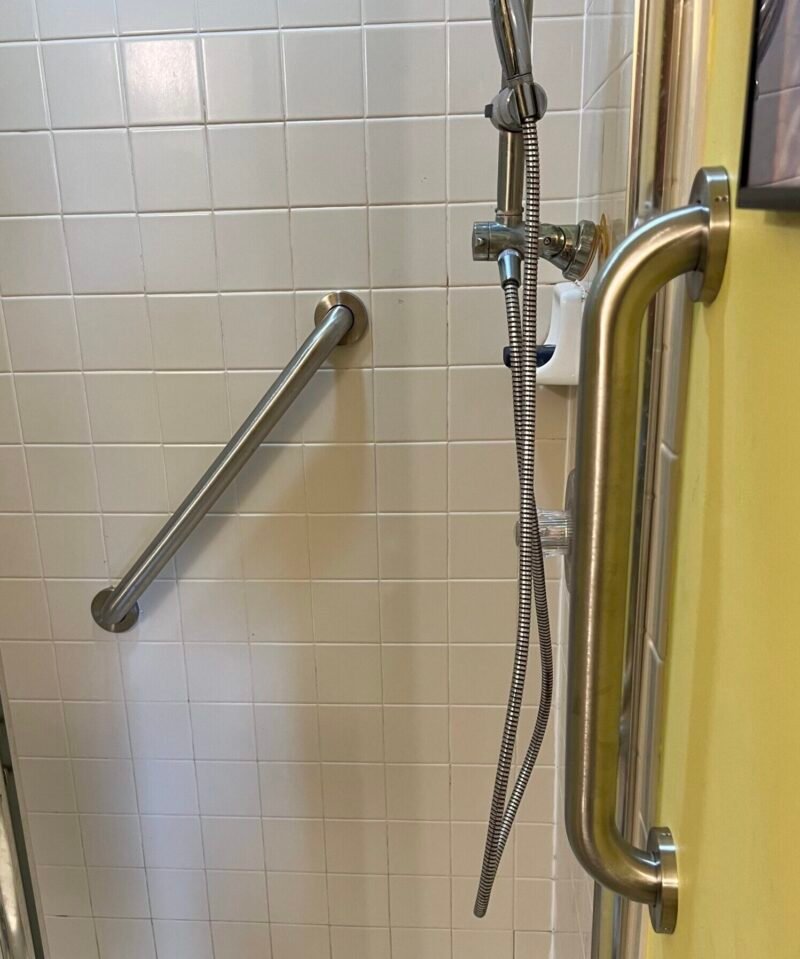
Grab Bar Installation in Pataskala, Ohio
Out in Pataskala, a grab bar that fails is worse than no grab bar at all. With no bar, you know to be careful. With a bar you trust, you put your full weight on it at the worst possible moment, and if it pulls out of the wall, it takes you down with it.
Here is the part most people never hear. The difference between a real grab bar and a dangerous one is not the bar you buy at the store. It is what the bar is anchored into. A quality bar screwed into nothing but drywall is a trap. A basic bar fastened into solid framing will hold a falling adult.
This page is about what makes a bar actually hold, and why that takes more care in some Pataskala homes than others. NextStep Bath Solutions installs grab bars across Pataskala, and Paul Knox does the work himself. When you call, he is the one who answers.
The Most Dangerous Bar Is the One That Looks Safe
Two things in a bathroom look like they will hold you and will not. The first is the towel bar. It is right there at hand height, and in a stumble people grab it on instinct. It is built to hold a towel, and it comes off the wall the moment real weight hits it. The second is the suction-cup bar sold as a no-drilling solution. It sticks to the tile until the day the seal lets go, usually with no warning.
A real grab bar is screwed permanently into the structure of the wall. That is the entire point. Anything that relies on adhesive, suction, or drywall alone is not a safety device, no matter how sturdy it looks the day it goes up. Falls are the leading cause of injury among older adults, and a bar that gives way turns a near miss into the fall it was supposed to prevent.
What a Grab Bar Actually Has to Hold
When you simply rest a hand on a bar, the load is light. When you start to fall and catch yourself, the load spikes well past your body weight, because a falling body adds force as it drops. That sudden yank is the moment the bar has to survive, and it is the moment a poorly anchored bar fails.
For the bar to hold, that force has to travel out of the bar, through its mounting plates and screws, and into something strong enough to absorb it. That something is the wood framing inside the wall. Quality bars are built to handle the load. The weak link is almost always the connection between the bar and the wall, which is exactly where the skill of the installation lives.
Anchoring Into Studs and Solid Blocking
There are two solid things to anchor a bar into. The first is a wall stud, the vertical wood framing inside the wall. The second is blocking, a piece of solid wood added between the studs specifically to back the bar. When a bar needs to go where there is no stud, the right move is to open the wall, add blocking, and mount into that, rather than trust an anchor in hollow drywall.
This is the part that separates a job done right from a job done fast. Studs do not always land where the bar needs to be for good placement. A careful installer does not move the bar to a worse spot just because a stud is there. He puts the bar where your hand needs it and makes the wall behind it strong enough to hold.
Older Farmhouse Walls: Plaster, Lath, and Surprises
Pataskala has a lot of older homes, and an older farmhouse asks for more care here than a new build. The walls are often plaster over wood lath instead of modern drywall, which behaves differently under a drill and hides its framing less predictably. The framing itself may not sit on the tidy spacing a newer home uses. And the tub is frequently heavy cast iron with its own surround.
None of that prevents a safe, lasting bar. It just means the installer has to find the real structure rather than assume it, and sometimes add blocking to get a sound anchor where the bar belongs. The reward is a bar that is as durable as the old house around it, mounted to framing that has held for generations and will hold for more.
Newer Subdivision Walls
In Pataskala’s newer subdivisions, the framing is modern and predictable, which makes anchoring more straightforward. But predictable does not mean automatic. The bar still has to hit a stud or solid blocking, and a fiberglass tub or shower surround needs proper backing so the mounting does not crush or crack the panel.
The principle is identical in any home, old or new. The bar is only as good as what it is fastened to. The assessment confirms what is behind your specific walls before a single hole is drilled.
How a Bar Gets Installed Right
Done correctly, the work follows a clear order. Paul locates the framing behind the wall, confirms where the bar needs to go for the way you move, and adds blocking if the right spot has no stud behind it. The bar is fastened with the proper hardware for the wall and the bar, and the penetrations through tile or a surround are sealed so water cannot get behind the wall over time.
The finished bar is tested before he leaves, so you are not the one who finds out whether it holds. That sealing and testing step is easy to skip and a real problem when it is skipped, especially in a wet area, which is why doing it right matters more than doing it quickly.
Cost, the Free Assessment, and the Distance Question
Cost depends on how many bars you need, where they go, and what is behind the walls. A bar that lands on a stud is simple. A bar that needs blocking added behind plaster is more involved. Because Pataskala homes range so widely, the honest number comes from seeing the bathroom in person.
It starts with a free in-home assessment, and yes, that includes the spread-out parts of Pataskala. The town is part of the core NextStep service area, so the distance is not a problem and the visit is no favor. Paul comes out, checks what is behind the walls, and gives you a written price with no obligation and no charge for the trip. There is no minimum project size, and senior and disability discounts are available, so ask when you call.
NextStep Bath Solutions is not a franchise and not a call center. Paul Knox does the assessment and the work, holds Ohio HIC License No. 00306, and carries insurance through Celina Insurance Group. Confirm coverage on the Pataskala service area page, or read more on the grab bar installation page.
Want grab bars that hold when you need them most? Start with a free in-home assessment.
Frequently Asked Questions
Are the suction-cup grab bars sold as no-drilling safe to rely on?
No. A suction bar holds until its seal lets go, often without warning, so it should never be trusted as a fall-prevention handhold. A real grab bar is permanently fastened into the framing inside the wall.
Can a grab bar be mounted where there is no stud?
Yes, the right way is to add solid blocking behind the wall and mount into that. A careful installer puts the bar where your hand needs it and makes the wall strong enough to hold, rather than moving the bar to a worse spot just to catch a stud.
Will this work in an old farmhouse with plaster walls?
Yes. Older Pataskala homes with plaster over lath can hold a sound, lasting bar. It takes finding the real framing rather than assuming it, and sometimes adding blocking, which the assessment sorts out before any work begins.
How much weight can a properly installed grab bar hold?
A quality bar anchored into studs or solid blocking is built to take the sudden load of a person catching a fall, which is far more than resting weight. The bar is only as strong as what it is fastened to, so the anchoring is what makes the rating real.
Who does the work, and is the assessment free?
Paul Knox does the work himself. NextStep Bath Solutions is owner operated, licensed under Ohio HIC License No. 00306, and insured through Celina Insurance Group. The in-home assessment is free, with no obligation and no charge for the trip.