Grab Bar Installation in Grove City, Ohio
A grab bar is the cheapest, fastest, highest-return safety change you can make in a Grove City bathroom. It is also the one most often done wrong, and the mistake is almost never the bar itself. It is where the bar gets put.
The common version of that mistake looks like this. Someone buys a bar at the store, finds a clear patch of wall, and mounts it there because that is where it fit. The bar is now in a spot the hand never reaches at the moment balance actually goes. It looks like a safety upgrade. It does almost nothing.
Placement is the whole game. This page walks through the zones where grab bars earn their keep, how mounting height changes with the person, and how to get it right. NextStep Bath Solutions installs grab bars across Grove City, and Paul Knox does the work himself. When you call, he is the one who answers.
Why Placement Decides Whether a Grab Bar Works
A grab bar only helps if your hand finds it at the exact instant you start to lose your footing. That instant is not random. It happens at predictable points: stepping over the tub wall, turning under the water, rising from the toilet. A bar placed where one of those movements happens is a lifeline. A bar placed three feet away on the only open wall is decoration.
Falls are the leading cause of injury among older adults, and the bathroom is where they happen most. Bathroom injuries send hundreds of thousands of people to the emergency room every year, and the risk climbs steeply with age. Good placement is what turns a grab bar from a gesture into real protection, so it is worth understanding the zones before anything goes on the wall.
Zone 1: Getting Into the Tub or Shower
The most dangerous moment in most Grove City bathrooms is crossing the tub wall. You stand on a wet floor, shift your weight to one leg, and lift the other over a slick edge. A vertical bar mounted at the entry gives your hand something to pull against and steady on through that whole transfer.
In an older ranch with a standard alcove tub, this is usually the first bar to consider, because the step over the wall is the single riskiest act in the room. If you are also thinking about lowering that wall entirely, a step-in conversion pairs naturally with an entry bar, and you can read about that on the Grove City step-in tub conversion page.
Zone 2: Inside the Tub or Shower
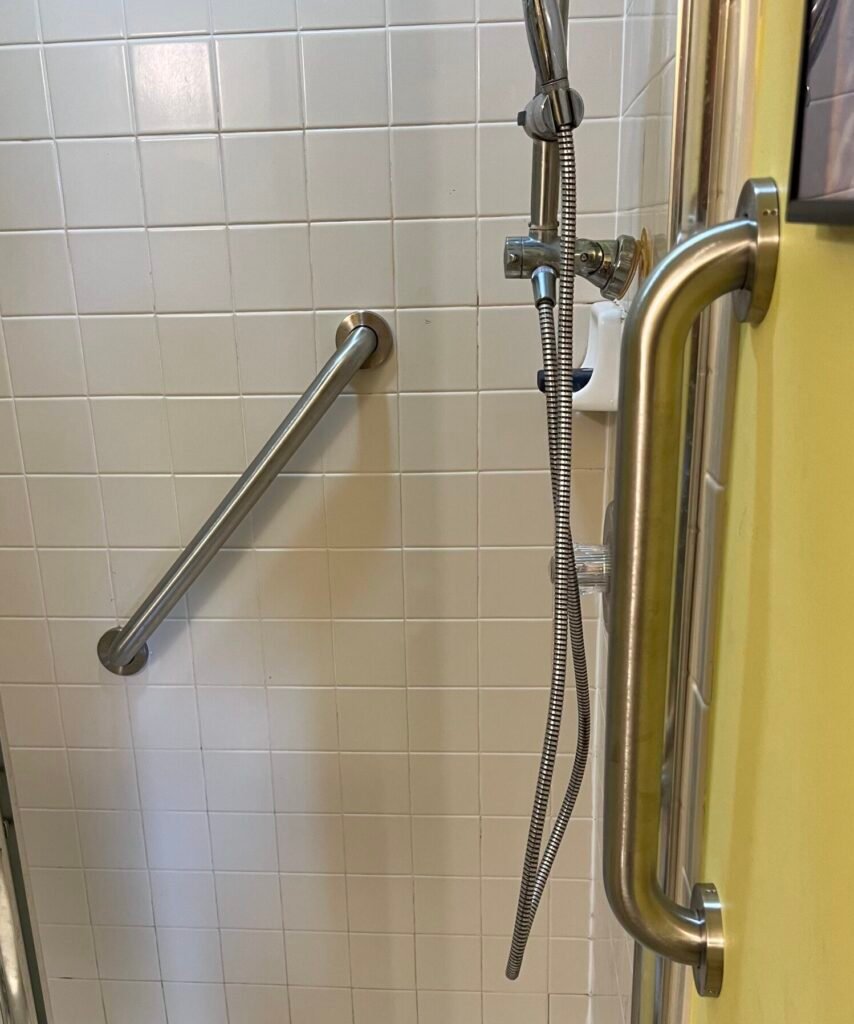
Once you are in, the danger does not stop. Standing on a wet surface, turning to rinse, reaching for soap, and bending to wash your feet all test balance on the most slippery footing in the house. A horizontal bar along the back or side wall gives you something to brace against while standing and moving. For someone who needs support while lowering onto a shower seat, an angled bar can make that motion safer.
The right answer here depends on how you bathe. Someone who showers standing needs a different setup than someone who sits. That is the kind of detail the in-home assessment is built to catch.
Zone 3: Beside the Toilet
The toilet is used more than any other fixture, and lowering down and standing back up is hard on aging knees and hips. A bar beside the toilet gives you a stable handhold for both motions. Where there is a wall close by, an angled or vertical bar works well. Where the toilet sits in the open with no adjacent wall, a fold-down bar mounted to the back wall gives you support and flips up out of the way when it is not needed.
This is also where a grab bar and a comfort height toilet work together. A taller seat shortens the distance you have to lower and rise, and a bar gives you something to push against. See the ADA toilet installation page for more on the seat height piece.
Zone 4: The Path Between
The fixtures get most of the attention, but the wet floor between them matters too. The step out of the tub onto a damp floor, the turn toward the sink, the reach for a towel: these are transition moments where a hand reaching for stability finds only a towel bar or a slick wall. A well-placed bar along that path closes the gap between the safe zones.
In the compact bathrooms common to older Grove City ranches, these paths are short, which is good, but they often include the most slippery few feet in the home. Mapping them is part of looking at the whole room rather than just the tub.
Mounting Heights and the Person Who Uses Them
There are general guidelines for grab bar heights. Horizontal bars on a tub or shower wall are often mounted somewhere in the range of 33 to 36 inches above the floor. But a guideline is a starting point, not an answer. The bar has to be set for the person who will actually use it.
Height, reach, grip strength, and which hand is dominant all change where a bar should go. A bar mounted at a textbook height that does not match the user is just a more expensive version of the wrong-spot mistake. Setting placement around the real person, in their real bathroom, is the difference between a bar that gets used with confidence and one that gets ignored.
One Bar or Several
You do not have to outfit the whole bathroom at once. The right place to start is wherever you already feel unsteady, which for most people is the tub entry or beside the toilet. From there you can add bars over time as needs change. There is no minimum project size, so a single, properly placed and anchored bar is a job worth doing right.
Grab bars also fit into the bigger aging-in-place picture for a Grove City home. If you are weighing the whole room, the aging in place bathroom modifications in Grove City page lays out how the pieces work together.
Cost and the Free Assessment
The cost of grab bar installation depends on how many bars you need, where they go, and what is behind the walls. A single bar in an easy spot is a small job. Several bars, or a spot that needs solid blocking added behind the wall, is more involved. The honest number comes from looking at your bathroom, which is exactly how every project starts.
It begins with a free in-home assessment. Paul comes to your Grove City home, watches how you move through the bathroom, maps where bars will actually do the most good, and gives you a written price with no obligation and no charge for the visit. There is no minimum project size, and senior and disability discounts are available, so ask when you call.
NextStep Bath Solutions is not a franchise and not a call center. Paul Knox does the assessment and the work, holds Ohio HIC License No. 00306, and carries insurance through Celina Insurance Group. You can read more about how this is done on the grab bar installation page, or confirm coverage on the Grove City service area page.
Want grab bars placed where they will actually catch you? Start with a free in-home assessment.
Frequently Asked Questions
Where should grab bars go in my Grove City bathroom?
The highest-value spots are the tub or shower entry, inside the bathing area, and beside the toilet, plus the wet path between them. The exact placement depends on how you move through the room, which Paul maps during the free in-home assessment.
How high should a grab bar be mounted?
Horizontal bars on a tub or shower wall are often set somewhere in the range of 33 to 36 inches above the floor, but the right height depends on the person’s height, reach, and grip. The bar is set for the person who will actually use it, not to a fixed number.
Can I just put a grab bar where there is open wall space?
That is the most common mistake. A bar only helps if your hand reaches it at the moment balance is at risk. A bar mounted for convenience rather than for the movement it needs to support does very little, which is why placement is mapped to how you actually use the bathroom.
Do I have to install several bars at once?
No. There is no minimum project size. Many Grove City homeowners start with one bar at the spot where they feel least steady and add others over time as their needs change.
Who does the work, and is the assessment free?
Paul Knox does the work himself. NextStep Bath Solutions is owner operated, licensed under Ohio HIC License No. 00306, and insured through Celina Insurance Group. The in-home assessment is free, with no obligation and no charge for the visit.